Friday, March 23, 2012

]
For our class assignment we had to find a song from popular culture dealing with gender, race or ethnicity. I showed "I'm A Barbie Girl" from Aqua and talked a bit about it, but wanted to elaborate on here. I have to admit I never played with Barbies as a child. It was just not something we had at our house. My two sisters and I had plenty of other dolls and toys, but never got into the Barbie-thing. I also have to admit that I have this song on my iPod and at times actually like listening to it. It is quite upbeat, until you pay attention to the words and the intended audience of the song.

Singing about how you can undress her everywhere and she can beg on her knees just makes me question who came up with these lyrics and thought this was a good idea or in any way appropriate associating them with a very popular toy for young girls. It just promotes outer appearance, materialism and being an object for men.

Other classmates brought in some more excellent examples. I think a lot of us listen to music without paying too much attention to lyrics and meaning, making songs popular that really should not be. We should pay more attention to things like that, because people get things stuck in their heads and think maybe because it is in a song and so many people are approving of it (by buying the record instead of speaking up about it), it is okay to think that way about women, etc. This can spiral out of control really quickly...

Aqua
Aquarium (1997)
Barbie Girl


- Hi Barbie!
- Hi Ken!
- You wanna go for a ride?
- Sure, Ken!
- Jump in!
- Ha ha ha ha!

I'm a Barbie girl in the Barbie world
Life in plastic, it's fantastic
You can brush my hair, undress me everywhere
Imagination, life is your creation

Come on, Barbie, let's go party

I'm a Barbie girl in the Barbie world
Life in plastic, it's fantastic
You can brush my hair, undress me everywhere
Imagination, life is your creation

I'm a blonde single girl in the fantasy world
Dress me up, take your time, I'm your dollie
You're my doll, rock and roll, feel the glamour and pain
Kiss me here, touch me there, hanky-panky

You can touch, you can play
You can say I'm always yours, oooh whoa

I'm a Barbie girl in the Barbie world
Life in plastic, it's fantastic
You can brush my hair, undress me everywhere
Imagination, life is your creation

Come on, Barbie, let's go party, ha ha ha, yeah
Come on, Barbie, let's go party, oooh, oooh
Come on, Barbie, let's go party, ha ha ha, yeah
Come on, Barbie, let's go party, oooh, oooh

Make me walk, make me talk, do whatever you please
I can act like a star, I can beg on my knees
Come jump in, be my friend, let us do it again
Hit the town, fool around, let's go party

You can touch, you can play
You can say I'm always yours
You can touch, you can play
You can say I'm always yours

Come on, Barbie, let's go party, ha ha ha, yeah
Come on, Barbie, let's go party, oooh, oooh
Come on, Barbie, let's go party, ha ha ha, yeah
Come on, Barbie, let's go party, oooh, oooh

I'm a Barbie girl in the Barbie world
Life in plastic, it's fantastic
You can brush my hair, undress me everywhere
Imagination, life is your creation

I'm a Barbie girl in the Barbie world
Life in plastic, it's fantastic
You can brush my hair, undress me everywhere
Imagination, life is your creation

Come on, Barbie, let's go party, ha ha ha, yeah
Come on, Barbie, let's go party, oooh, oooh
Come on, Barbie, let's go party, ha ha ha, yeah
Come on, Barbie, let's go party, oooh, oooh

- Oh, I'm having so much fun!
- Well, Barbie, we're just getting started!
- Oh, I love you Ken!


Sunday, March 11, 2012

Primetime Characters


In our class discussion we talked about the number of white primetime characters versus the number of African American, or Latino ones, as well as the number of women versus men. We also briefly touched on the number of gay characters and doing a bit more research trying to find the most current numbers, I came across a report released by the Gay & Lesbian Alliance Against Defamation (GLAAD) in 2010. It stated another interesting fact I hadn't thought about. Out of the 587 series-regular roles on scripted primetime TV, only 6 of them have disabilities. What was even more striking was the fact that only one of the six actors portraying someone with a disability actually had one him-/herself.

This made me think of our discussion of the early portrayal of African Americans and how it used to be white males with painted faces. How come the networks don't employ actors with disabilities out there if the role calls for it, yet they make an able-bodied person pretend. Something is very wrong with that picture. According to the article that published these results, there are plenty of actors with disabilities looking for auditions and roles. Sometimes the type of character they are able to play is limited by their disability, so depriving these actors and actresses of the few roles that call for someone with a disability seems illogical. Just like we don't have whites play African Americans anymore, we should give people with disabilities their shot at being on primetime TV.

Wednesday, March 7, 2012

Print Ads and an Update to the Lego Post


Talking about advertising in class, I was actually quite shocked to see some of the ads that ran a few decades ago. Some of the copy printed on the ads was just terrible! The sad thing is that the way women are portrayed now in advertisements hasn't really changed all that much. They are still often dismembered or simply an object. Dr. Pepper is even going so far as to excluding women altogether in their new campaign for Dr. Pepper 10 - apparently NOT for women...This in itself is insulting. Not that I want to drink this particular soda, but just to exclude consumers based on their sex is wrong. You would think in the 21st century ad executives could come up with a better campaign to entice the male market segment to buy their product, without discriminating against women.

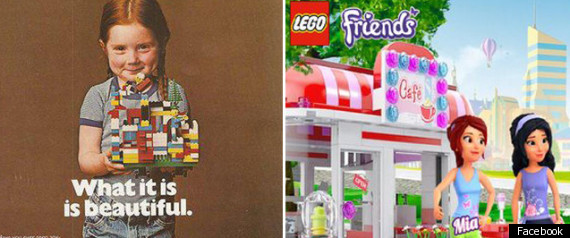
I also found another interesting article about the new Lego Friends line I had talked about in an earlier post. In this article they talk about the backlash against Lego for engaging in such obvious gender-based marketing. It also showed an ad from the 80s and one recent one. It's amazing how that changed.

While back then it was not only okay for girls to wear jeans and a normal t-shirt, they were also 'allowed' to play with the regular Lego pieces of all colors and build whatever came to their minds. Today, girls are only wearing tank tops in girly colors, and play with pink and purple colored pieces and more girly sets such as the cafe featured in the ad.

I think while it is really bad that advertisers primarily portray women as half naked objects, who are only good for seductively gazing at the camera selling various products, it is really bad what the advertising industry is doing to the children. Little girls are younger and younger when they learn to look sexy, be skinny and how to cook for the man. While we should empower little girls and get rid of the notion that 'girly' activities are worth less in the male dominated society, we push girls into these stereotypes, robbing them of their imagination and setting them up for future image and self-esteem problems.

Below is a short video, in which a 4-year-old questions why girls have to buy only pink stuff. If only marketers would listen...

Thursday, February 23, 2012

What teens learn from magazines

Whether their parents buy them a subscription, their friends have one or they are just at Barnes&Noble waiting for mom to finish picking out books, teens read magazines specifically catered to them. There are countless of them out there - Teen Vogue, Seventeen, Girls' Life, J-14, American Cheerleader, M! Magazine and Popstar! just to name some of the most popular ones.

As we discussed in class, teens get a lot of information from those magazines and take it seriously as well. They are more dependent on and influenced by these than adults reading Glamour or Cosmopolitan. This made me interested in what topics exactly are covered by these magazines. I went on the Seventeen Magazine website and at first just looked at the different tabs teens can click to get to articles in the various categories. This alone was slightly shocking.

The tabs are:
1) quizzes, games and fun
2) fashion
3) beauty
4) celebrities
5) love life
6) health
7) college life
8) parties and prom

Aside from the college tab - and maybe the health one - all others promote superficial things that might lead to the teens questioning their appearance, their love life (or lack thereof, which could throw them into a crisis easily), and their fashion sense. If they don't have the latest trends, they are either going to bug their parents to spend a ridiculous amount of money on brand name stuff, or are going to be depressed that they have such a boring, last-season wardrobe. They also learn everything about the best parties, which is really exactly what they should focus on at that age (and I definitely mean that in a sarcastic way).

The cover I selected for this post shows the winner of the TV show America's Next Top Model, a show where one can witness tiny, skinny models on a weekly basis. I think it is time for editors and parents who buy these magazines for their daughters to reconsider what to promote to future leaders of this country. Do we really want girls to only focus on looks, parties and fashion?

There are more and more stories in the news about bullying, depressed teens, and those with eating disorders, starving themselves to look like the airbrushed person on the cover of their favorite magazine. This is wrong and does not help girls turn into successful business women.

Monday, February 13, 2012

Valentine's Day


Valentine's Day is just around the corner and I have noticed a lot or articles online helping people deal with this day revolving around love, flowers and candy. Topics range from "What to get her", "How to survive this day" to "Last minute preparations." What I have noticed throughout the headlines though was the focus on women. They provided tips on what to do when you are single, which made it seem like it's tragic for a woman to be single on this day, yet perfectly fine for a man. They talked about how to get through this day of seeing so many happy couples, while knowing one is alone and without a man. This made me wonder how all those girls survive the rest of the year, since society clearly focuses so much on relationships and one's status of it. You go get your hair done and one question almost certainly revolves around whether one has found a boyfriend yet. Same thing at nail salons and similar gossip prone venues.


It made me think about the movies we watched in class and our subsequent discussion about what had or hadn't changed since the 50s. During the 50s many girls simply wanted to get married, find the perfect man and lead a happy life at home, caring for the children and playing housewife. Then came the 60s and women wanted to do things on their own, be more respected and have the same rights as their male counterparts. Yet you come across articles like the ones mentioned above today, just to realize that there is still so much focus on relationships. As if a woman can't be happy without a man by her side at all times. She has to read articles on how to survive being single and how to find a man as soon as possible so she is not alone another day. Inequalities still persist and women are not helping their cause by thinking they need a hot boyfriend or a new man to be successful. Women need to learn how to be happy on their own and society needs to accept single women, not look down on them or pity them. It is perfectly fine for a man to play the field or stay single for a bit, yet women are judged and others wonder why she can't find or doesn't want a leading man in her life right now.

Saturday, February 11, 2012

Toys and Gender Stereotypes


For a recent assignment I was looking for a newspaper or scholarly article dealing with race or gender issues. After a little bit of looking around I found the perfect one. The article "Lego my stereotypes! Blocks aimed at girls raise issues about gender and play" appeared in the Detroit Free Press on February 8th, 2012. In the introduction the author talks about the difficulties he was faced with when shopping for an appropriate Lego set for his daughter. Most of the kits left were geared more towards boys and there were hardly any gender-neutral ones at all. He continues to talk about Lego's newest line called "Lego Friends", which includes kits with slightly larger figures and themes historically more appealing to girls, such as a beauty salon, a cafe, and a bakery.

Lego, which started with mostly gender-neutral items, made the conscious decision to target boys when the company was struggling a few years ago. The introduction of this new line is supposed to recapture the girl's market. The new line has been received with mixed emotions though from scholars and customers; some are embracing the new items, while others criticize Lego for using too many gender stereotypes. The article finishes with a portrait of a Detroit family with three daughters, all Lego enthusiasts. The Jacobs' two older daughters like the more traditional sets, while the youngest of them is more girly and has taken a liking to the new "Lego Friends."

In my opinion this article is a great example illustrating gender stereotypes and companies telling parents what is appropriate for their boys and girls with the types of toys offered. It agrees completely with our class discussion that children receive and are supposed to play with different toys based on their gender and that colors are also gender specific. Girls should play with items that are pink and purple, while boys shouldn't touch these, as they are not 'manly' enough. With this new "Lego Friends" line, Lego emphasizes these stereotypes and pushes the parents to stay within them since not many want to give their boys a girly toy/play kit or give their delicate little girls a toy made for rough and tumble boys.

I think Lego could have taken a better approach to recapture this market segment, by promoting their kits in general as gender-neutral or making the new line less stereotypical. As a child I played with Legos a lot and I had all different kinds of kits. By making ones targeted specifically at females, it limits these young girls to those kits and makes it less appropriate to play with Star Wars or Harry Potter themed kits. Last time I checked though, neither one of those movie franchises only had male fans. Apparently though building them out of Legos, with black, brown, grey and generally dark colored parts, and subsequently playing with them - which might involve simulated fighting - is more appropriate for boys.

I believe parents should pick the kits based on their children's interests, not gender. If the girl likes Star Wars, get her a Star Wars themed kit. If she prefers puppies, get her the new "Lego Friends" puppy house. The same should hold true for boys, but our society still has a long way to go before 'girly' things are acceptable for boys. These decisions regarding toys should not be based on what is appropriate based on a child's gender, but on the child's interests and preferences. I think it's sad when children are forced to play with certain toys their parents pick out for them based on appropriateness. They should be able to figure out on their own what they like and enjoy without having stereotypes forced on them at such a young age.


Monday, February 6, 2012

Women and their rights over time

Watching Mona Lisa Smile all the inequalities women faced in the fifties and still today became apparent. Members of the female sex were not supposed to want a career or stay happily single; their only goal was to find a good husband and have kids, caring for them and making sure the house was clean and neat.

This made me think about the recent uprisings in the Arab world and the role women still play today in these societies. We have heard of women setting themselves on fire and die to get attention, men killing their wives for bearing a daughter and women in general having to be covered up from head to toe and not being allowed to leave the house without a male companion. Most women in these parts of the world never get asked whether they would like to attend a University or pursue a career; they are forced into arranged marriages and subsequently into the roles of housewife and mother;

While the male attitude in the fifties cannot be applauded, at least society changed and women have more choices and freedoms. One can only hope that the situation gets better for the millions of women still suppressed; It is shocking to read that in the 21st century women still die for no real reasons and have in no way the same rights as their male counterparts. While it might have been frowned upon in the fifties for a woman to be single and pursuing a career, women in the Arabic world today might die because they want to pursue a life society only deems appropriate for a man.