Friday, March 23, 2012

]
For our class assignment we had to find a song from popular culture dealing with gender, race or ethnicity. I showed "I'm A Barbie Girl" from Aqua and talked a bit about it, but wanted to elaborate on here. I have to admit I never played with Barbies as a child. It was just not something we had at our house. My two sisters and I had plenty of other dolls and toys, but never got into the Barbie-thing. I also have to admit that I have this song on my iPod and at times actually like listening to it. It is quite upbeat, until you pay attention to the words and the intended audience of the song.

Singing about how you can undress her everywhere and she can beg on her knees just makes me question who came up with these lyrics and thought this was a good idea or in any way appropriate associating them with a very popular toy for young girls. It just promotes outer appearance, materialism and being an object for men.

Other classmates brought in some more excellent examples. I think a lot of us listen to music without paying too much attention to lyrics and meaning, making songs popular that really should not be. We should pay more attention to things like that, because people get things stuck in their heads and think maybe because it is in a song and so many people are approving of it (by buying the record instead of speaking up about it), it is okay to think that way about women, etc. This can spiral out of control really quickly...

Aqua
Aquarium (1997)
Barbie Girl


- Hi Barbie!
- Hi Ken!
- You wanna go for a ride?
- Sure, Ken!
- Jump in!
- Ha ha ha ha!

I'm a Barbie girl in the Barbie world
Life in plastic, it's fantastic
You can brush my hair, undress me everywhere
Imagination, life is your creation

Come on, Barbie, let's go party

I'm a Barbie girl in the Barbie world
Life in plastic, it's fantastic
You can brush my hair, undress me everywhere
Imagination, life is your creation

I'm a blonde single girl in the fantasy world
Dress me up, take your time, I'm your dollie
You're my doll, rock and roll, feel the glamour and pain
Kiss me here, touch me there, hanky-panky

You can touch, you can play
You can say I'm always yours, oooh whoa

I'm a Barbie girl in the Barbie world
Life in plastic, it's fantastic
You can brush my hair, undress me everywhere
Imagination, life is your creation

Come on, Barbie, let's go party, ha ha ha, yeah
Come on, Barbie, let's go party, oooh, oooh
Come on, Barbie, let's go party, ha ha ha, yeah
Come on, Barbie, let's go party, oooh, oooh

Make me walk, make me talk, do whatever you please
I can act like a star, I can beg on my knees
Come jump in, be my friend, let us do it again
Hit the town, fool around, let's go party

You can touch, you can play
You can say I'm always yours
You can touch, you can play
You can say I'm always yours

Come on, Barbie, let's go party, ha ha ha, yeah
Come on, Barbie, let's go party, oooh, oooh
Come on, Barbie, let's go party, ha ha ha, yeah
Come on, Barbie, let's go party, oooh, oooh

I'm a Barbie girl in the Barbie world
Life in plastic, it's fantastic
You can brush my hair, undress me everywhere
Imagination, life is your creation

I'm a Barbie girl in the Barbie world
Life in plastic, it's fantastic
You can brush my hair, undress me everywhere
Imagination, life is your creation

Come on, Barbie, let's go party, ha ha ha, yeah
Come on, Barbie, let's go party, oooh, oooh
Come on, Barbie, let's go party, ha ha ha, yeah
Come on, Barbie, let's go party, oooh, oooh

- Oh, I'm having so much fun!
- Well, Barbie, we're just getting started!
- Oh, I love you Ken!


Sunday, March 11, 2012

Primetime Characters


In our class discussion we talked about the number of white primetime characters versus the number of African American, or Latino ones, as well as the number of women versus men. We also briefly touched on the number of gay characters and doing a bit more research trying to find the most current numbers, I came across a report released by the Gay & Lesbian Alliance Against Defamation (GLAAD) in 2010. It stated another interesting fact I hadn't thought about. Out of the 587 series-regular roles on scripted primetime TV, only 6 of them have disabilities. What was even more striking was the fact that only one of the six actors portraying someone with a disability actually had one him-/herself.

This made me think of our discussion of the early portrayal of African Americans and how it used to be white males with painted faces. How come the networks don't employ actors with disabilities out there if the role calls for it, yet they make an able-bodied person pretend. Something is very wrong with that picture. According to the article that published these results, there are plenty of actors with disabilities looking for auditions and roles. Sometimes the type of character they are able to play is limited by their disability, so depriving these actors and actresses of the few roles that call for someone with a disability seems illogical. Just like we don't have whites play African Americans anymore, we should give people with disabilities their shot at being on primetime TV.

Wednesday, March 7, 2012

Print Ads and an Update to the Lego Post


Talking about advertising in class, I was actually quite shocked to see some of the ads that ran a few decades ago. Some of the copy printed on the ads was just terrible! The sad thing is that the way women are portrayed now in advertisements hasn't really changed all that much. They are still often dismembered or simply an object. Dr. Pepper is even going so far as to excluding women altogether in their new campaign for Dr. Pepper 10 - apparently NOT for women...This in itself is insulting. Not that I want to drink this particular soda, but just to exclude consumers based on their sex is wrong. You would think in the 21st century ad executives could come up with a better campaign to entice the male market segment to buy their product, without discriminating against women.

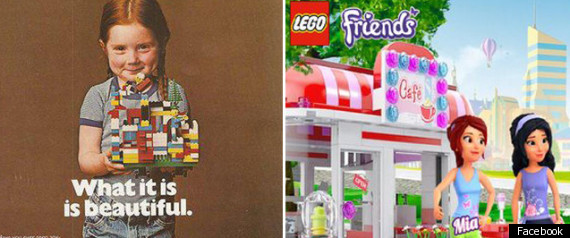
I also found another interesting article about the new Lego Friends line I had talked about in an earlier post. In this article they talk about the backlash against Lego for engaging in such obvious gender-based marketing. It also showed an ad from the 80s and one recent one. It's amazing how that changed.

While back then it was not only okay for girls to wear jeans and a normal t-shirt, they were also 'allowed' to play with the regular Lego pieces of all colors and build whatever came to their minds. Today, girls are only wearing tank tops in girly colors, and play with pink and purple colored pieces and more girly sets such as the cafe featured in the ad.

I think while it is really bad that advertisers primarily portray women as half naked objects, who are only good for seductively gazing at the camera selling various products, it is really bad what the advertising industry is doing to the children. Little girls are younger and younger when they learn to look sexy, be skinny and how to cook for the man. While we should empower little girls and get rid of the notion that 'girly' activities are worth less in the male dominated society, we push girls into these stereotypes, robbing them of their imagination and setting them up for future image and self-esteem problems.

Below is a short video, in which a 4-year-old questions why girls have to buy only pink stuff. If only marketers would listen...